
ANNUAL REPORT
Explore the Group’s key figures and highlights of the year. Get insight into our strategy and perspectives.
key figures
Key financial data
2025in million USD | 2025 | 2024 |
|---|---|---|
| Revenue and other operating income | 371.0 | 393.0 |
| EBITDA | -15.6 | -13.1 |
| EBITDA ex-Restructuring and One-Off Expenses | +0.9 | -8.0 |
Get the complete financial data in our 2025 Annual Report PDF
At a glance

Core Digital Security
450
Operators400 M
Subscribers
Cybersecurity
520+
Customers60 billion
Alerts per day
Internet of Things
500
CustomersRevenue per segment



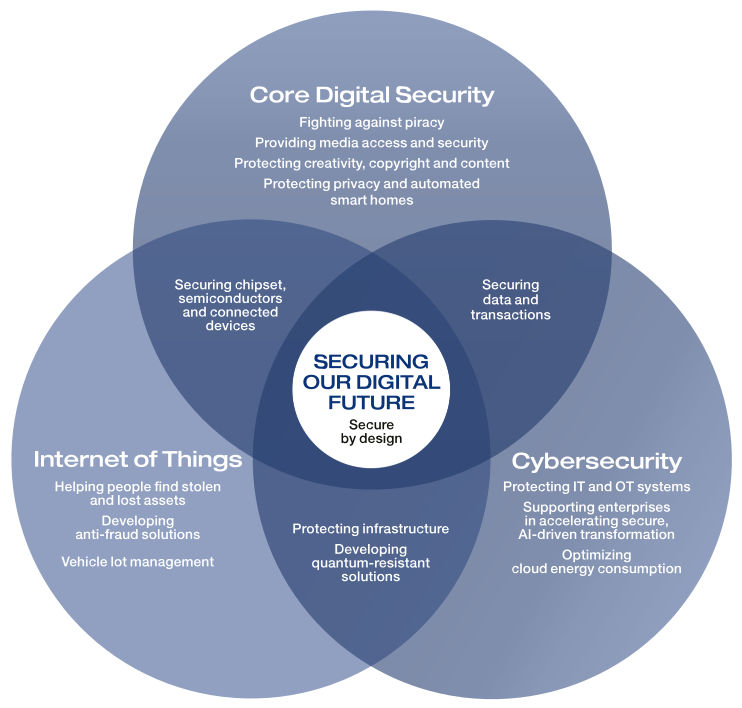
Strategic focus
Market Highlights
Core Digital Security 

Europe
NAGRAVISION Teams Up with the English Football League
Protecting live sports content is increasingly critical for leagues and broadcasters in the digital age. Fighting live sports piracy is a top priority for the English Football League (EFL) and the wider industry to safeguard the value of live content, support member clubs, and deliver the best possible fan experience. By leveraging NAGRA Streaming Security’s dynamic piracy monitoring, the EFL can accurately quantify piracy threats against its live sports content.

Europe
NAGRAVISION Partners with Bango
NAGRAVISION Partners with Bango to Bring Over 100 Subscription Services to OpenTV ENTera. By leveraging the Digital Vending Machine® (DVM™) from Bango through the OpenTV management console, service providers can enable greater consumer retention and more efficient audience segmentation.

Europe
NAGRAVISION and Broadpeak Unite to Combat Live Sports Piracy with Real-Time Disruption Technology
As sports streaming grows in popularity, providers face increasing pressure to protect live content and ensure seamless delivery. The integrated solution addresses the unique challenges facing today’s sports streaming providers, where millions of viewers demand flawless real-time delivery during high-stakes events. The platform delivers comprehensive end-to-end protection against evolving piracy threats including illegal re-streaming, credential sharing, unauthorized access, and CDN leeching. Its AI-powered analytics engine continuously monitors CDN traffic and DRM license requests to detect suspicious activity patterns, enabling immediate disruption of pirate streams without impacting legitimate viewers.

Asia / Pacific
NAGRAVISION and MediaTek Reinvent Streaming Security with Next-Gen DRM Protection
As digital entertainment consumption grows, device-level security becomes essential to protect premium content. NAGRAVISION and MediaTek Reinvent Streaming Security with Next-Gen DRM Protection. The collaboration will deliver an on-device security solution that enables renewable content protection and eliminates the risks of credential management applied at the factory level, ushering in a new era of trust, DRM robustness, and protection for digital entertainment.
Cybersecurity 

Stay ahead of evolving threats
Kudelski Security continued its transformation by expanding differentiated Managed Detection and Response (MDR) services and integrating new platform capabilities. Investments in a state-of-the-art Counter Adversary Unit enhanced threat intelligence, detection, and incident response, reinforcing the company’s commitment to proactive protection. Strategic partnerships with leading hyperscalers and cybersecurity providers, including support for CrowdStrike Next-Gen SIEM and Google SecOps, strengthened integrated, scalable, intelligence-driven operations.

Enhancing MDR operations
Kudelski Security has advanced the integration of artificial intelligence (AI) across its Managed Detection and Response (MDR) operations to boost efficiency, strengthen threat detection, and improve client outcomes. AI-assisted investigations, intelligent alert correlation, behavioral analytics, and automation of key processes allow security analysts to detect and respond to threats faster while maintaining accuracy, consistency, and scalability across global operations.

Accelerating innovation through OT Security Center
Rising cyber threats, stricter regulations, and the convergence of IT and OT environments continued to drive strong market demand for Kudelski Security’s services. In response, the company expanded its OT security portfolio and, in 2025, established an OT Security Center of Excellence to accelerate innovation, share best practices, and provide specialized expertise in industrial cybersecurity.

New AI Security Service portfolio
In 2024, the introduction of new security capabilities for artificial intelligence represented a strategic milestone in the growth of our portfolio. Kudelski Security’s new AI Security portfolio is a comprehensive suite of services designed to help businesses address the unique risks posed by AI-powered systems and applications. These capabilities empower organizations to adopt AI securely, effectively, and in compliance with regulations. Kudelski Security has been focused on AI security and enabling innovation for over five years – long before the advent of mainstream AI tools like ChatGPT and Microsoft Copilot.
Internet of Things 

Growing the RecovR brand through strategic partnerships
In 2025, Kudelski IoT’s RecovR solution built on the momentum from 2024, continuing its expansion through strategic partnerships with financial services companies including Ally, Assurant, and JM&A. This channel-driven approach enabled access to major dealer networks, including eight locations of the largest Chevrolet dealer group in the U.S., representing over USD 2 million in potential annual revenue.

RecovR partnered with Stotz Equipment to support agriculture
Beyond automotive, RecovR partnered with Stotz Equipment to support agriculture, compact construction, and golf and turf markets, delivering inventory management, asset tracking, and theft recovery solutions for dealers and operators. In defense, a five-year renewal at Joint Base Pearl Harbor-Hickam strengthened the tracking and utilization of aerospace ground equipment, enabling more predictable maintenance and enhancing mission readiness.

Growing industry demand
Kudelski IoT is experiencing increasing long-term demand for its GPS tracking technology as dealerships and consumers seek reliable solutions beyond factory-installed systems. Automotive professionals and vehicle owners alike face challenges with OEM lot management and recovery solutions, which are often fragmented, limited in functionality, and slow to respond in critical moments. With advanced tracking tools and expertise, Kudelski IoT delivers comprehensive solutions that unify multi-brand lot management, and enhance theft protection, provide limited warranty benefits, ensuring rapid recovery when every second counts.

Navigating a period of market uncertainty
In 2025, a combination of macroeconomic and policy-driven external headwinds weighed on revenue momentum and extended customer decision cycles across key end markets. In U.S. automotive retail, ongoing uncertainty related to tariff policy and broader trade negotiations created a “wait-and-see” environment, leading many organizations to defer discretionary investments and slow change-management initiatives until cost and demand conditions became clearer.